Minimal models of quantum dynamics
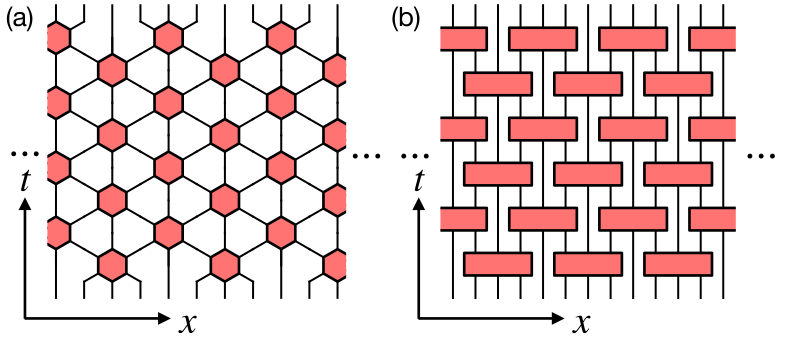
The idea is to write down a model which retains the absolutely fundamental features of quantum dynamics—unitarity and spatial locality between spins—but throws away all other structure by making the dynamics random in space and time.
At first, this might seem eccentric: it’s far from what physical Hamiltonians look like. So why would we do this? The claim is that some universal features of entanglement growth arise from unitarity and locality alone. Even things we usually think of as fundamental, like energy conservation and a fixed set of eigenstates, may not matter for these features.
I am interested in the coarse-grained descriptions that emerge from these models, especially the entanglement membrane picture, which describes entanglement growth geometrically at large scales. My work on operator and state entanglement, and on two-stage thermalization, connects quantum dynamics to effective statistical mechanics.
Coarse-grained entanglement dynamics · Two-stage thermalization
Ergodicity breaking
When does an interacting system fail to explore its available states? I am interested in Fock-space localization and the mechanisms that preserve memory even in systems with otherwise chaotic dynamics. Thinking of basis states as vertices of a graph makes this question concrete: which paths through the space of configurations are accessible, and which are blocked by constraints or interference?
I use entanglement and spectral statistics to probe the boundary between thermalizing and nonthermal behavior. My recent work on zero modes asks how a large nonthermal manifold can coexist with, and be isolated by, a chaotic bulk.

Tensor networks
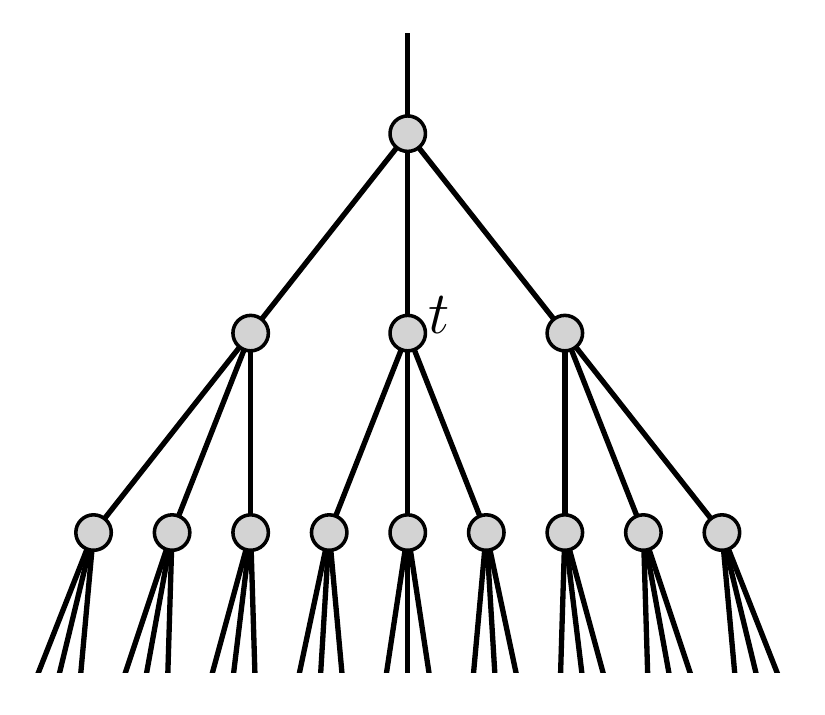
My current fixation is tree tensor networks. Their branching geometry gives us a tractable setting for studying how local structure shapes global entanglement. My collaborators and I are currently using them extensively to study new sign and entanglement transitions in random tensor networks.
Separately, in my ILIAD fellowship project, I am using tree tensor networks to explore minimal models of training dynamics. For me, this is a bridge back to minimal models of quantum dynamics: a simple structure in which we can follow how correlations develop and identify the mechanisms behind collective behavior.